
The Tall Ship Glenlee’s much-loved figurehead has been craned back into position following conservation work, marking another milestone in the historic Clyde-built ship’s £1.8 million restoration project
One of Glasgow’s most recognisable maritime figures has returned to her place overlooking the River Clyde, as The Tall Ship Glenlee’s figurehead, affectionately known as “Mary Doll”, was craned back into position earlier this week following an extensive programme of conservation work.
The striking operation saw the restored wooden figurehead carefully lifted and reinstated beneath Glenlee’s bowsprit, returning a familiar face to the bow of the 130-year-old Clyde-built sailing ship.
Her return comes as major work continues on Glenlee’s masts and rigging, being undertaken by specialist contractor TS Rigging as part of a £1.8 million project supported by the National Heritage Memorial Fund to safeguard the historic vessel for future generations.

Mary Doll’s conservation was led and carried out in Glenlee’s own workshop by crew member Andrew Kelsey, with support from the wider crew and the museum manager. This is the first time the figurehead has been removed from the vessel since she was installed as part of Glenlee’s restoration in 1999.
Carved from laminated cedar by Scottish sculptor Marvin Elliott, the figurehead has spent more than a quarter of a century exposed to the Clyde’s wind, rain, frost and sunshine.
The availability of a crane during the current mast and rigging works created a rare opportunity to carefully remove her from the ship and undertake a more extensive programme of conservation than would normally be possible.
Once ashore, years of accumulated dirt and biological growth were carefully removed, including a rather unflattering green “beard” which had developed beneath her chin.
Despite more than 25 years facing the Scottish weather, the timber was found to be in remarkably good condition. Minor areas of delamination were stabilised and repaired, while the figurehead was carefully documented to create a detailed conservation record for the future.
Old paint layers were removed before new primer and undercoat were applied, followed by fresh enamel paint matched as closely as possible to her original appearance.
Fiona Greer, Development Director at The Tall Ship Glenlee, said:
“Having the opportunity to watch Mary Doll being lifted back into position at the bow is a wonderful moment for everyone involved with Glenlee and another very visible milestone in this hugely important programme of work.
“For more than 25 years she has welcomed visitors to the ship and watched over the Clyde, so Glenlee simply hasn’t looked quite herself while Mary has been away in the workshop.
“There is something particularly special about the fact that this conservation has been carried out here at Glenlee by Andrew, one of our own crew. The care being given to Mary Doll, alongside the major work to our masts and rigging, is all part of ensuring that this significant Clyde-built ship survives to inspire generations to come.”
A figurehead with a Glasgow character – and a remarkable predecessor
Mary Doll takes her affectionate nickname from the character played by Elaine C. Smith in the iconic Glasgow-set comedy Rab C. Nesbitt, but the carving has also become part of a much older maritime tradition.
For centuries, figureheads were regarded by sailors as the spirit of a vessel, watching over the ship and those who sailed aboard her.
Glenlee’s figurehead story is particularly unusual because the vessel effectively has two.
When Glenlee was launched at Port Glasgow in 1896, her original figurehead was carved by local sculptor John Roberts for just £4 – around £300 in today’s money.
That carving travelled the world with the vessel through an extraordinary working life which saw the ship sail under four different names — Glenlee, Islamount, Clarastella and finally Galatea — and under British, Italian and Spanish ownership.
When Glenlee finally returned home to the Clyde in 1993, however, her original figurehead did not come with her.
Following the vessel’s decommissioning after decades as the Spanish naval training ship Galatea, the figurehead had been removed and placed on display at the naval arsenal at La Graña, near Ferrol in Spain, where it remains today.
According to the history of Glenlee’s rescue and restoration, when the possibility of returning the carving to Scotland was raised with the Commandant of the Ferrol Naval School, his memorable response was: “Certainly — as soon as you give us back Gibraltar.”

With the figurehead remaining in Spain, Marvin Elliott was commissioned to create the carving which now stands at Glenlee’s bow.
Recent historical research undertaken by Lauren Henning, Learning and Museum Manager at The Tall Ship Glenlee, has also uncovered compelling evidence that the carving preserved in Spain may indeed be the very same figurehead which looked out across the Clyde when Glenlee was first launched 130 years ago.
Historic photographs from the ship’s years as Islamount, Clarastella and Galatea show a remarkably consistent female figure at the bow.
Even more compelling is an account written in 1918 by apprentice sailor Ernest “Andy” Andersen, who recorded being sent beneath the jib boom to clean the figurehead. His detailed description, including her abundant hair, handkerchief held against her chest, flowing dress, necklaces and rings, closely corresponds with features still visible on the carving preserved in Spain.
Lauren Henning, Learning and Museum Manager at The Tall Ship Glenlee, said:
“Mary Doll may have been created as part of Glenlee’s restoration, but after more than 25 years at the bow she has acquired an important history of her own. She is now part of the story of the ship and deserves the same thoughtful conservation and care that we give to the historic vessel itself.
“What makes Glenlee’s figurehead story especially fascinating is that our recent research has strengthened the case that the figurehead preserved in Ferrol could be the original carving made for Glenlee in Port Glasgow in 1896.
“That means we potentially have two noteworthy chapters of the same story: the original figurehead in Spain, which may have watched over this vessel for almost a century and through four different identities, and Mary Doll here in Glasgow, who has become the face of the restored Glenlee.
“It feels very fitting to see Mary return to her place today, ready to watch over the ship and the Clyde once again.”

Restoring a survivor of the Clyde
Built in Port Glasgow in 1896, Glenlee is one of the few remaining Clyde-built sailing ships still afloat anywhere in the world.
Her current £1.8 million programme of works represents a major investment in the future of the historic vessel, with specialist work on the ship’s masts and rigging being undertaken by TS Rigging.
The project has created dramatic scenes on the Clyde this year, with cranes manoeuvring Glenlee’s enormous masts and yards, some weighing several tonnes, as specialist teams work to preserve the ship and her traditional rig.
The reinstatement of Mary Doll represents another important step in that programme and restores one of the ship’s most distinctive features.
After a summer in the workshop, freshly conserved, documented and repainted, Mary Doll is once again looking out from Glenlee’s bow – continuing a maritime tradition stretching back centuries and welcoming visitors aboard one of Glasgow and Scotland’s most remarkable survivors of the age of sail.

We are delighted to announce that the Tall Ship Glenlee has been awarded funding through the Royal Academy of Engineering’s Ingenious public engagement programme.
This prestigious scheme supports innovative projects across the UK that connect the public with engineers and engineering, helping to inspire new audiences and broaden understanding of the profession.
Introducing STEM at Sea
Our funded project, STEM at Sea, will bring maritime engineering to life for young learners by working in partnership with local primary schools and Malin Group.
Together, we will co-produce a new suite of STEM-based workshops as part of Glenlee’s onboard learning programme. These sessions will use the ship itself as a hands-on learning environment, exploring the real engineering challenges behind her design, construction and operation.
Learning Through Heritage
Through STEM at Sea, pupils will:
- Discover the engineering principles behind historic sailing ships
- Take part in and design interactive, enquiry-led workshops onboard Glenlee
- Connect classroom STEM learning with real-world applications
- Engage directly with engineering professionals and maritime specialists
By collaborating with schools and industry partners, the project will ensure that the workshops are relevant, inspiring and shaped by the needs of both learners and educators.
Inspiring Future Engineers
Glenlee offers a unique platform to explore engineering through heritage. This funding will allow us to expand our learning offer and create meaningful opportunities for young people to engage with STEM in a creative and accessible way.
We hope that STEM at Sea will spark curiosity, build confidence, and encourage more young people to see engineering as something they can be part of.
We look forward to sharing more as the project develops.
https://raeng.org.uk/news/ingenious-round-20-awardee-announcement

On Wednesday, 11 March, the Tall Ship Glenlee was delighted to welcome representatives from the Spanish Navy and the Spanish Consul General based in Edinburgh on board the ship.
The visit celebrated Glenlee’s long and meaningful connection with Spain. From 1922, the ship served for sixty years under Spanish ownership as a training vessel for the Spanish Navy under the name Galatea. In June 1993, she returned to the River Clyde, where she had originally been built almost a century earlier.
The delegation was welcomed to Glasgow by the Lord Provost, Jacqueline McLaren, who presented the visitors with a tie made from Glasgow tartan as a gesture of civic hospitality. During their time on board, guests enjoyed a tour of the ship, sharing memories and stories connected to Glenlee’s long and varied history.
A highlight of the visit was a presentation by Captain Juan Escrigas Rodríguez of the Spanish Navy, who shared his research and historic photographs of the vessel during her years of Spanish service. Captain Escrigas has a particularly close personal connection to the ship. He is the grandson of two commanders of Galatea and has maintained strong professional and personal links with the vessel throughout his career.
A historian of the Spanish Navy, Captain Escrigas has written extensively on its history, including research on Galatea. He currently serves as Director of the Maritime Museum in Madrid, which holds an important collection of artefacts, photographs and archival material relating to the ship. Among his own personal collection is the original Glenlee ship’s bell from 1896, which was presented to his grandfather in the 1920s.
The visit also included presentations from Elizabeth Allen, Vice-Chair of the Tall Ship Glenlee Trust, and Museum Manager Lauren Henning, who shared updates on the restoration work that has taken place since the ship’s return to the Clyde and outlined the Trust’s priorities for the future.
The day celebrated the strong historical ties between Scotland and Spain through the story of Glenlee, while also marking the beginning of a renewed relationship between the Spanish Navy and the Tall Ship Glenlee Trust.

On Thursday, 16 July 1998, all three lower mast sections were successfully lifted and carefully slotted into position. Beneath the main mast, a small wooden box was ceremonially placed by Hamish Hardie and Jamie White. Inside were a 1998 gold sovereign and a silver dollar, along with a scroll acknowledging the members of the Trust and Ship Committee who had contributed to the restoration. The scroll also recorded thanks to the US National Park Service’s San Francisco Maritime Museum, which had granted Jamie a secondment to research, plan, and develop the restoration of the rig.

As this solemn ceremony took place, ten-year-old Tom Gibson stood proudly beside his grandad, Murray Scrimgeour, watching the mast being stepped. Suddenly realising he too had a shiny coin in his pocket, Tom made his own contribution—dropping a 10p coin into the mast step alongside the official box.
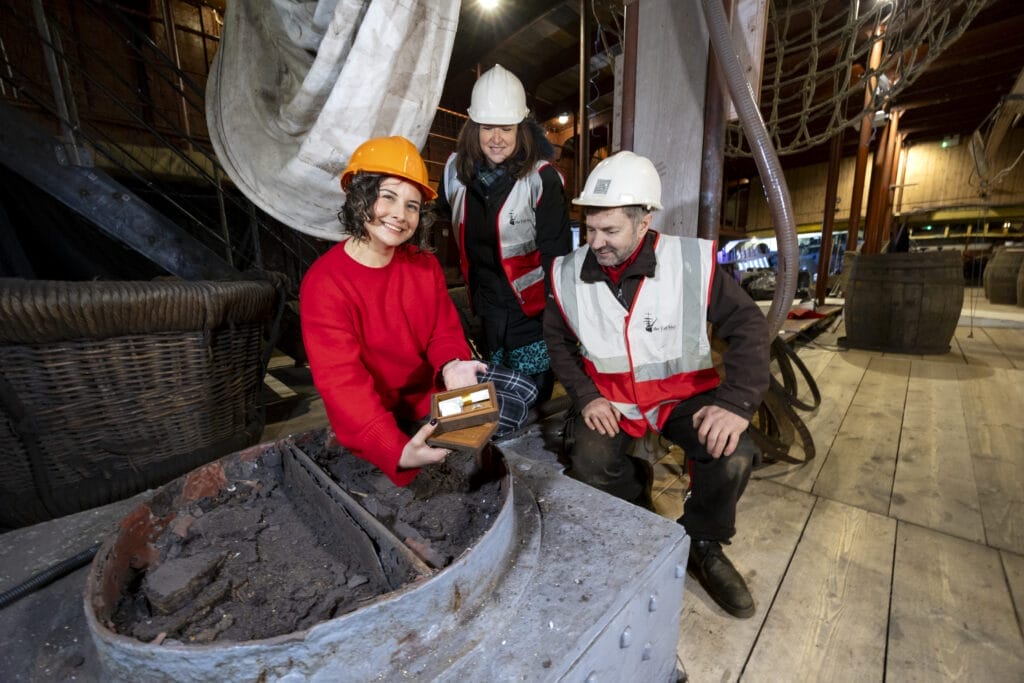
For the next 28 years, both the box and Tom’s coin remained safely hidden. Then, on Friday 16 January 2026, they were rediscovered during the lifting of the masts by TS Rigging. Tom, now an engineer with CalMac, was delighted to hear the news, saying, “I never thought I would see it again!”

During the current restoration, the box and its contents will be kept safe in the Museum store before being returned to their rightful place—perhaps accompanied by a new 2026 coin. And, of course, Tom’s coin will be put back too.
Placing coins beneath the main mast before stepping or lifting the masts is an ancient maritime tradition, believed to bring good luck to the ship.

UNIVERSALLY known in Glasgow as The Tall Ship Glenlee, its distinctive masts are a familiar and much-loved sight, reminding people of the time when the River Clyde was bustling with traffic on its water.
Now, this week, for the first time in 30 years, the floating museum’s famous masts are being removed for essential conservation work.
Two of her three masts will travel south of the border, bound for a specialist workshop in Maldon, Essex.
The vessel sits alongside the Riverside Museum and is owned by The Tall Ship Glenlee Trust, an independent charity.
The team at TS Rigging, which has years of experience working with historic vessels throughout the UK, such as RRS Discovery, HMS Gannet and the Cutty Sark, will carry out detailed analysis of the strength and condition of the metal. Any necessary repairs will be carried out in the coming months.
Glenlee is set to have an entire new set of running rigging and the standard rigging is to be serviced. These traditional skills are very rare and have even been added to the Heritage Crafts endangered list.
Once complete, the masts will be returned to Glasgow and reinstalled on Glenlee in the summer.
The first phase of The Tall Ship Glenlee’s refurbishment focused on the internal hull and steel work and was completed in spring last year.
The second phase, also funded by a £1.8m grant from the National Heritage Memorial Fund, marks the first major overhaul of the ship’s rigging in three decades.
It represents a big change, albeit temporary, for the ship and its important place on Glasgow’s map.
Glenlee was built 130 years ago further down the River Clyde, in the town of Port Glasgow. The steel-hulled ship, designed to carry cargo across the world, was built by Anderson Rodger in the Bay Yard.
In 1896, The Tall Ship Glenlee was originally fitted with three masts made mainly of steel, with wooden sections at the top to reduce overall weight. For the first 20 years of her working life, these masts were her only means of propulsion, driving her across the world’s oceans, using wind power alone.
During this time, the rig endured severe weather and heavy seas, with some voyages causing significant damage that required repair at sea or in port.
She served as a British cargo sailing ship for over 20 years. From 1922 until 1979, by then named Galatea, the vessel was used by the Spanish Navy for training. During this time, the original wooden sections were removed and replaced with an entirely new steel rig.
By the 1990s she was in a sad state of disrepair before being rescued by the Clyde Maritime Trust, now the Tall Ship Glenlee Trust, in 1993. It was at this point she returned to the River Clyde.
By 1999, The Tall Ship Glenlee had been restored to her former glory by American expert sail rigger, Jamie White. The vessel has since become a popular museum, visitor attraction and events venue.
Her current berth is behind Glasgow’s famous Riverside Museum.
Chris Wood, a rigger with TS Rigging, the company working on Glenlee’s conservation said:
“Vessels such as Glenlee were once commonplace, but have now become a rarity largely consigned to history. To work on an original Victorian tall ship that has been saved for the nation is a privilege.
“The skills required to maintain these types of heritage vessels are as rare as the ships themselves. This unusual project gives a much needed opportunity to keep these skills alive both for old hands and new trainees, having recently been added to the endangered crafts list.”
John Monasta, Associate Director of Beckett Rankine, the maritime civil engineering consultancy project managing The Tall Ship Glenlee’s refurbishment, said:
“Rigging refurbishment is a normal part of a tall ship’s lifecycle, and after roughly 30 years, the Glenlee was due for it. We are pleased to have the experts at TS Rigging on board to carry out this next phase of work, as part of ensuring the ship’s long-term preservation.
“Beckett Rankine is committed to preserving maritime heritage for future generations, and this is an important step in Glenlee’s future.”
Fiona Greer, Development Director of The Tall Ship Glenlee, said:
“We are so pleased that this next stage of looking after our Tall Ship Glenlee is happening. Maintaining an historic vessel is an expensive but essential business: we want to ensure that Glenlee remains in best possible condition.
“Being able to upgrade her rigging with the funding received from National Heritage Memorial Fund is something we have been planning for a long time.
“People have asked us about watching the process as it happens as it’s not something one sees every day. We are recommending that people watch from Govan side or at the Govan-Partick Bridge footbridge. We don’t recommend being close to the ship because of the proximity of cranes.
“I’d also like to reassure all visitors who are booked in for events or thinking of visiting or booking The Tall Ship Glenlee we will be open between the periods during which the conservation work is happening.”

© Martin Shields
On 3 December 1896, Glenlee first slipped into the water at Port Glasgow—beginning a remarkable life that would take her across the world’s oceans. Over the decades that followed, she sailed under several flags, weathered countless voyages, and served in roles her original builders could never have imagined.
In 1993, nearly a century after her launch, Glenlee finally came home to the Clyde. Since then, she has been lovingly restored and cared for as one of Scotland’s great maritime treasures.
As we mark 129 years since her launch, we invite you to celebrate with us by exploring a selection of photographs capturing Glenlee throughout her long and storied life.


We are delighted to announce that our very own volunteer John Aitken has been named Joint Winner of the 2025 Marsh Volunteer Individual Award, presented as part of this year’s National Historic Ships UK Awards.
The Awards celebrate outstanding contributions to maritime heritage across the UK, recognising the volunteers, organisations, and vessels working to keep historic ships alive for future generations. We are incredibly proud to see John recognised at a national level for the passion, skill, and warmth he brings to the Tall Ship Glenlee.
The Tall Ship Glenlee is proud to have long-standing ties to National Historic Ships UK, having previously been named Flagship of the Year in 2021 and recognised as part of the National Historic Fleet for her national significance.
John’s Contribution to Glenlee
Since joining the Tall Ship Glenlee Trust three years ago, John has become an integral part of our team. His engineering skills support vital maintenance work over the winter months, while in summer he can be found aboard the ship welcoming visitors and sharing his enthusiasm for Scotland’s maritime heritage.
He is also the beloved star of our festive programme—donning the Santa suit each Christmas to bring seasonal magic to families across Glasgow.
This award acknowledges the dedication, generosity, and joy he brings to everything he does, both behind the scenes and in the public eye. We couldn’t be more grateful.
A Well-Deserved Honour
The Marsh Volunteer Awards, run in partnership with the Marsh Charitable Trust, recognise exceptional individual and group volunteering within the UK’s historic vessel sector. Volunteers form the backbone of maritime heritage, and this award shines a spotlight on the vital contribution they make to keeping our ships afloat—literally and figuratively.
John’s award is supported by glowing endorsements from across the Glenlee team, celebrating both his technical expertise and his boundless enthusiasm for sharing the ship’s story.
Thank You, John
On behalf of everyone at the Tall Ship Glenlee Trust—congratulations, John, and thank you for all you do. This recognition is richly deserved, and we are honoured to have you as part of our crew.

Today, we share in the deep sadness felt around the world at the news that the historic vessel Falls of Clyde has been scuttled in Honolulu.
Built on the River Clyde in 1878, Falls of Clyde was a proud example of Scotland’s shipbuilding heritage and a symbol of the ingenuity, skill, and ambition that once made the Clyde the greatest shipbuilding river in the world. Her loss is a poignant reminder of how fragile our maritime heritage can be without sustained care, support, and investment.
Preserving ships like Glenlee requires not only technical expertise but also the dedication of volunteers, the commitment of communities, and the generosity of funders who understand that these vessels are living links to our past. The story of Falls of Clyde should strengthen our resolve to ensure that no other historic ship is left without the support it needs to survive. There are lessons to be learned here for all of us who care about our shared maritime story.
With the loss of Falls of Clyde, Glenlee now becomes one of only four Clydebuilt sailing ships of our type left afloat in the world. We will continue to honour her sister ships by safeguarding Glenlee for future generations, so that the legacy of the Clyde continues to inspire and endure.
— The Tall Ship Glenlee Team

The Tall Ship Glenlee is thrilled to announce that it has been recognised as the winner of a prestigious tourism award.
The Scottish Thistle Awards, with headline sponsors Abbey: The Destination Experts, celebrate the very best of the tourism and events industry in Scotland. They have become an annual celebration of excellence, collaboration and innovation within one of the country’s most important sectors. The Tall Ship Glenlee was named as Best Visitor Attraction at the West of Scotland Thistle Awards on Thursday 25 September at a ceremony at the Radisson Blu in Glasgow.

The Scottish Thistle Awards 2025 celebrate excellence, innovation, and outstanding achievements across Scotland’s tourism and hospitality industry. Organised by VisitScotland, the ceremony recognises businesses and individuals who deliver exceptional visitor experiences and contribute to Scotland’s global reputation as a world-class destination.
This category recognises the variety of opportunities provided to Scotland’s visitors, and the attractions which provide world-class service with authentic, memorable experiences.
Lauren Macrae, Visitor Experience Manager at The Tall Ship Glenlee, said:
“We are incredibly honoured to win the Scottish Thistle Award for Best Visitor Attraction in the West of Scotland. This recognition is a testament to our entire team and the community that supports The Tall Ship Glenlee. We are proud to celebrate Scotland’s maritime heritage and will continue creating unforgettable experiences for all who step aboard.”

The Tall Ship Glenlee is one of Glasgow’s most treasured heritage icons. Built in 1896, Glenlee is now a rare example of a Clyde-built sailing ship and one of only five of its kind still afloat in the world. Now preserved as a visitor attraction, museum, learning centre, and community hub, the ship welcomes over 100,000 visitors each year.
Fiona Greer, Development Director at The Tall Ship Glenlee, said:
“We are delighted to receive this recognition, which reflects the hard work of our team and the continued support of our partners, funders and the wider tourism sector. The Tall Ship Glenlee is an important part of Scotland’s heritage, and this award strengthens our commitment to ensuring the ship remains a leading visitor attraction and a valued contributor to the region’s rich cultural and tourism landscape.”
This week, we had the pleasure of welcoming Rodney and Liz Jones to the Tall Ship Glenlee. Rodney is the grandson of Charles Sleggs, who served as Chief Officer of the Islamount between 1918 and 1919, before the ship passed into Italian ownership.

Rodney brought a wonderful gift with him: a beautifully framed photograph of his grandfather alongside his wife and eight daughters. He presented it to our Vice Chair, Elizabeth Allen, who gratefully accepted it on behalf of the Trust.
Over tea in the café, Liz shared her research into Charles Sleggs’ remarkable career. She told the story of 1918, when he stepped up to command the Islamount after the captain and much of the crew fell ill with “Java fever” shortly after leaving Indonesia.
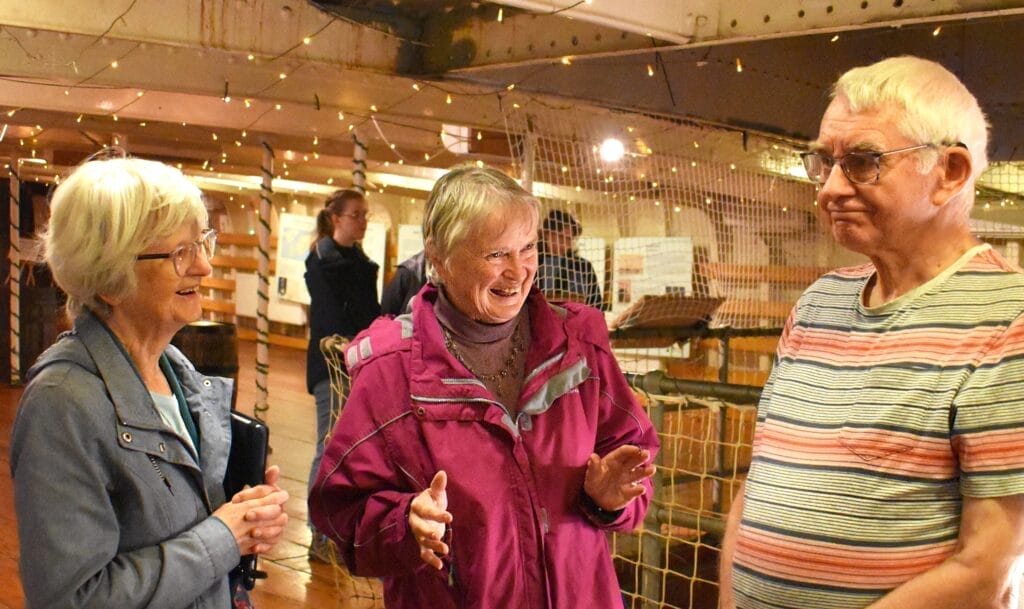
Afterwards, we took Rodney and Liz on a tour of the Glenlee. Liz shared stories of life at sea in Sleggs’ time, bringing to life the challenges and experiences his generation of sailors faced.
We ended the morning feeling inspired, grateful, and glad to welcome Rodney and Liz as part of the Glenlee family.